Process Classification Framework® (PCF)

Міжгалузевий Process Classification Framework® (PCF) - це таксономія міжфункціональних бізнес-процесів, призначена для об'єктивного порівняння організаційної ефективності всередині організацій та між ними.
Process Classification Framework® (PCF) була розроблена APQC та її компаніями-членами як відкритий стандарт для сприяння вдосконаленню за допомогою управління процесами та бенчмаркінгу, незалежно від галузі, розміру чи місцезнаходження.
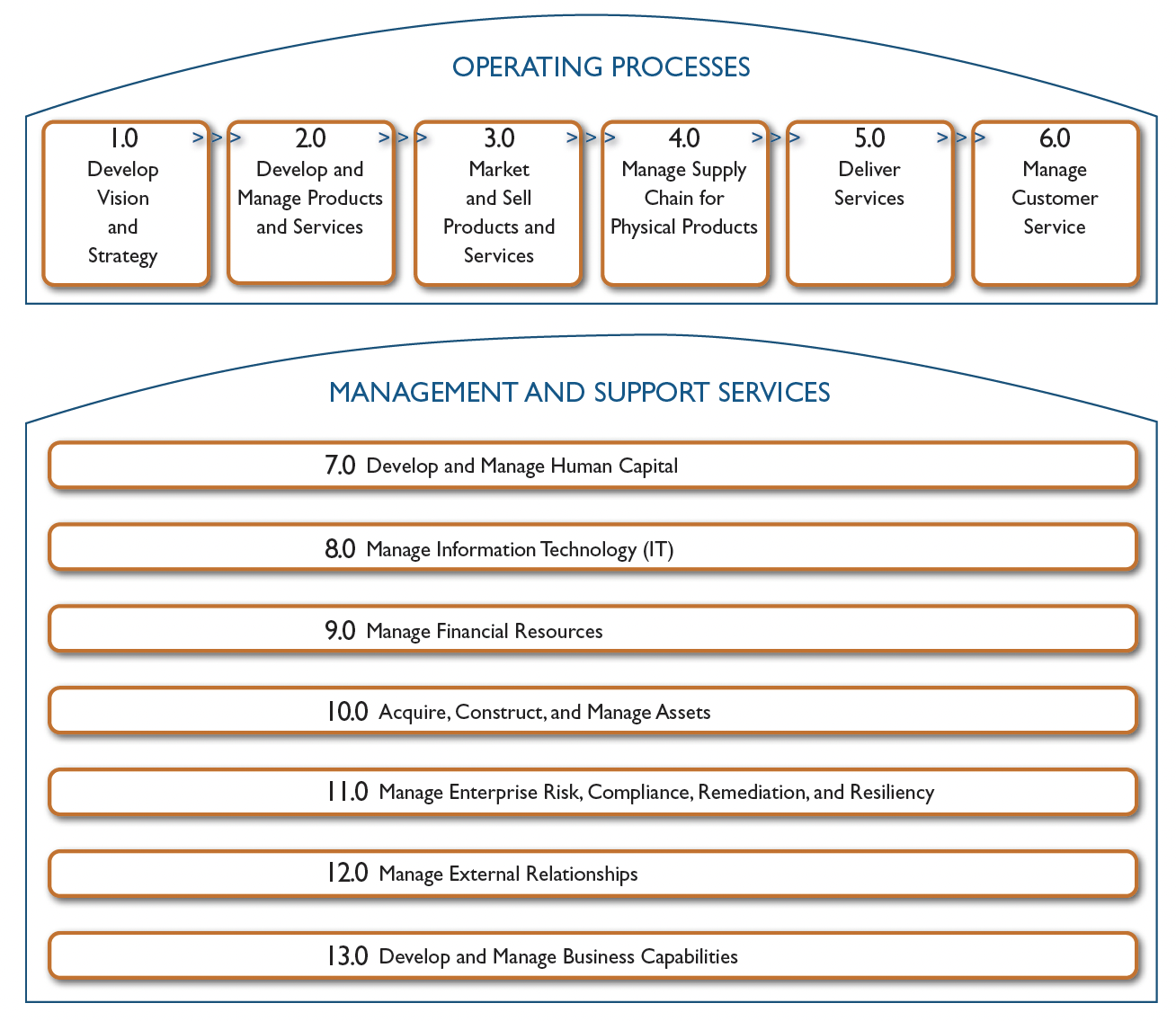
Process Classification Framework® (PCF) організовує операційні та управлінські процеси в 13 категорій на рівні підприємства, включаючи групи процесів і понад 1 000 процесів та пов'язаних з ними видів діяльності. PCF, пов'язані з ним заходи та визначення доступні для безкоштовного завантаження на сайті www.apqc.org/pcf
Фреймворк для вдосконалення процесів (The Framework For Process Improvement)
Досвід показує, що потенціал бенчмаркінгу для значного поліпшення полягає в проведенні нестандартних порівнянь і пошуку інформації, яку зазвичай не можна знайти в рамках внутрішньогалузевих парадигм.
Щоб уможливити цей корисний бенчмаркінг, APQC Process Classification Framework (PCF)® слугує високорівневою, галузево нейтральною моделлю процесів підприємства, яка дозволяє організаціям бачити свої бізнес-процеси з міжгалузевої точки зору.
Ця міжгалузева структура вже понад 20 років творчо використовується тисячами організацій по всьому світу. PCF є основою для бази даних APQC Open Standards Benchmarking® (OSB) та роботи консультативної ради, що складається з лідерів світової індустрії. Кожна версія PCF буде продовжувати вдосконалюватися в міру того, як база даних OSB буде розвивати визначення, процеси та заходи.
Історія Process Classification Framework® (PCF)
Міжгалузева система класифікації процесів (Process Classification Framework®) спочатку була задумана як таксономія бізнес-процесів і спільна мова, за допомогою якої організації-члени APQC могли б порівнювати свої процеси з контрольними показниками.
Початковий проект включав APQC та понад 80 організацій, які були зацікавлені в просуванні використання бенчмаркінгу в Сполучених Штатах та в усьому світі. З моменту свого створення в 1992 році, PCF зазнав оновлень більшої частини свого контенту. Ці оновлення підтримують структуру в актуальному стані з урахуванням того, як організації ведуть бізнес у всьому світі. У 2014 році APQC працювала над вдосконаленням міжгалузевої PCF і оновила низку галузевих рамок класифікації процесів.
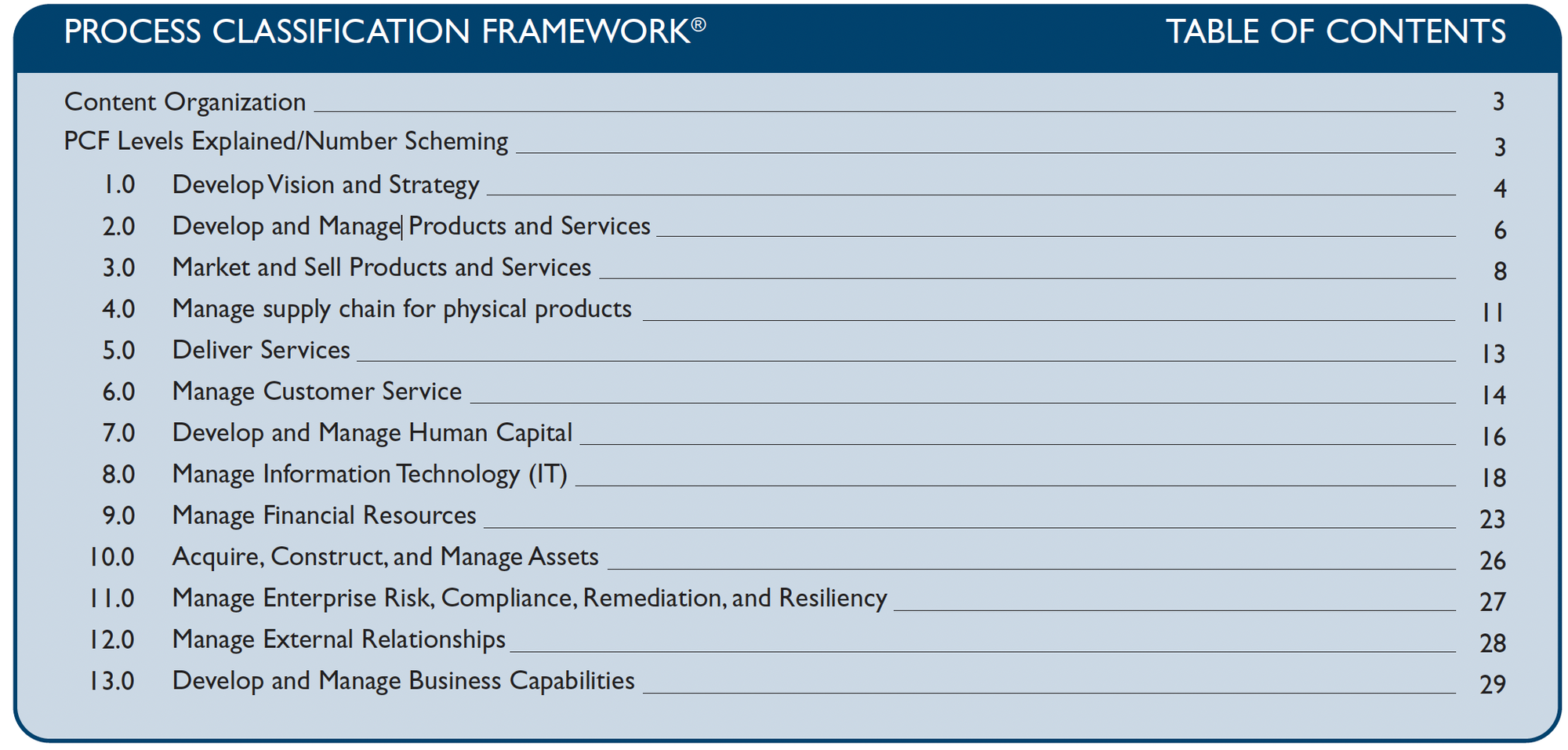
PCF Levels Explained/Number Scheming
- 1.0 Develop Vision and Strategy
- 2.0 Develop and Manage Products and Services
- 3.0 Market and Sell Products and Services
- 4.0 Manage supply chain for physical products
- 5.0 Deliver Services
- 6.0 Manage Customer Service
- 7.0 Develop and Manage Human Capital
- 8.0 Manage Information Technology (IT)
- 9.0 Manage Financial Resources
- 10.0 Acquire, Construct, and Manage Assets
- 11.0 Manage Enterprise Risk, Compliance, Remediation, and Resiliency
- 12.0 Manage External Relationships
- 13.0 Develop and Manage Business Capabilities
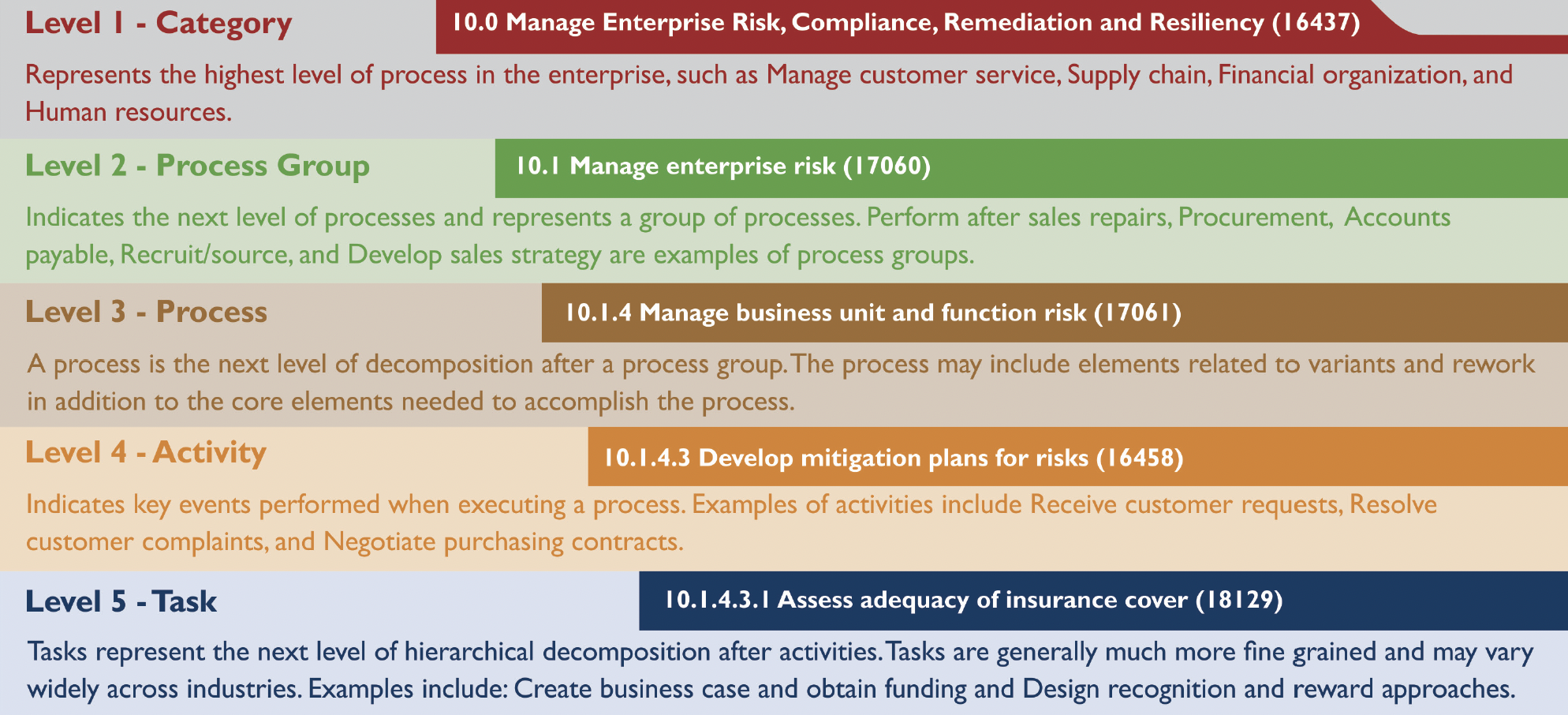
Пояснення рівнів Process Classification Framework® (PCF)
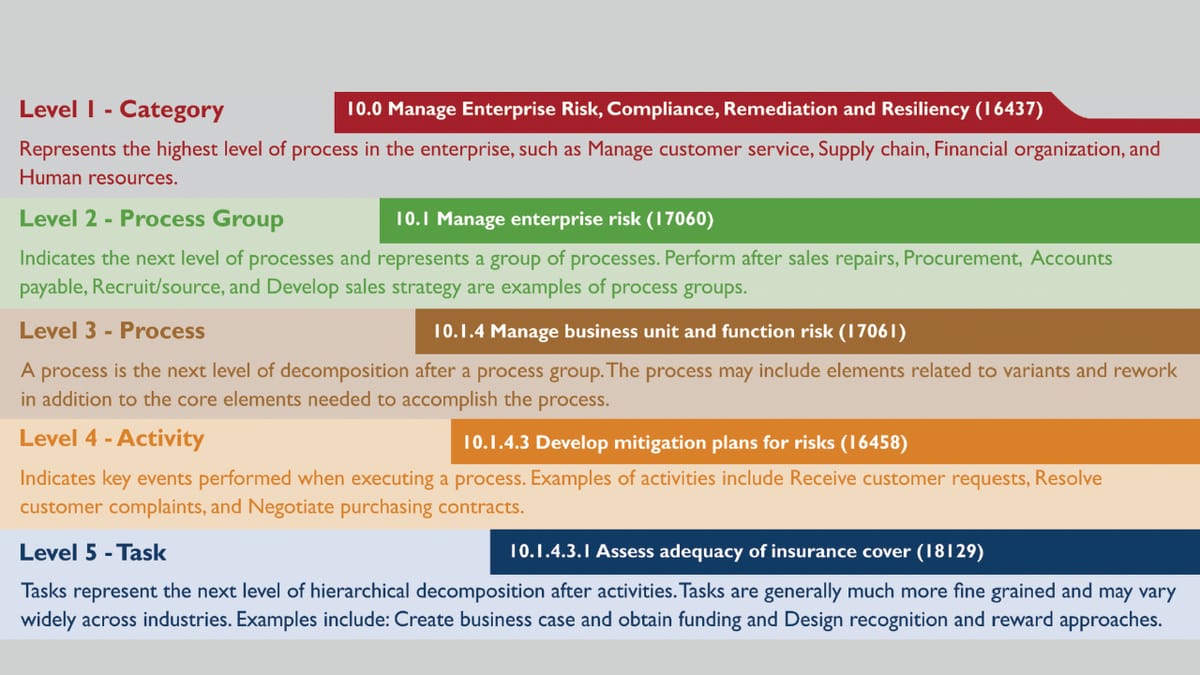
PCF в ієрархії має до 5ти рівнев
8.0 Manage Information Technology (IT) (10008)
8.1 Develop and manage IT customer relationships (20608)
8.1.1 Understand IT customer needs (20609)
- 8.1.1.1 Understand IT customer communities (20610)
- 8.1.1.2 Assess IT customer operational capabilities (20611)
8.1.2 Identify IT customer transformation needs (20612)
- 8.1.2.1 Understand business requirements for IT capabilities (20613)
- 8.1.2.2 Understand IT landscape (20614)
- 8.1.2.3 Develop IT visioning (20615)
- 8.1.2.4 Outline IT service expectations (20616)
8.1.3 Plan and communicate IT services (20617)
- 8.1.3.1 Manage IT customer expectations (20618)
- 8.1.3.2 Define future IT services (20619)
- 8.1.3.3 Determine IT performance indicators (20620)
- 8.1.3.4 Create IT marketing messages (20621)
- 8.1.3.5 Create IT service marketing plan (20622)
8.1.4 Provide IT transformation guidance (20623)
- 8.1.4.1 Develop IT transformation plans (20624)
- 8.1.4.2 Collect IT customer requirements (20625)
- 8.1.4.3 Analyze IT customer requirements (20937)
- 8.1.4.4 Identify and prioritize IT opportunities (20626)
- 8.1.4.5 Facilitate solution design activities (20627)
- 8.1.4.6 Prioritize IT outcomes (20628)
- 8.1.4.7 Develop business cases (20629)
- 8.1.4.8 Support business case (20630)
- 8.1.4.9 Develop transformation roadmap (20631)
8.1.5 Develop and manage IT service levels (20632)
- 8.1.5.1 Understand IT service requirements (20633)
- 8.1.5.2 Forecast IT service demand (20634)
- 8.1.5.3 Maintain IT services catalog (20635)
- 8.1.5.4 Define service level agreement (20636)
- 8.1.5.5 Maintain IT customer contracts (20637)
- 8.1.5.6 Negotiate and establish service level agreements (20638)
- 8.1.5.7 Develop and maintain improvement processes (20640)
8.1.6 Manage IT customer relationships (20641)
- 8.1.6.1 Establish relationship management mechanisms (20642)
- 8.1.6.2 Understand IT customer strategy (20643)
- 8.1.6.3 Understand IT customer environment (20644)
- 8.1.6.4 Communicate IT capabilities (20645)
- 8.1.6.5 Manage IT requirements (20646)
8.1.7 Analyze service performance (20648)
- 8.1.7.1 Assess SLA compliance (20649)
- 8.1.7.2 Triage SLA compliance issues (20650)
- 8.1.7.3 Collect feedback about IT products and services (20647)
- 8.1.7.4 Synthesize and distribute IT performance information (20938)
8.2 Develop and manage IT business strategy (20652)
8.2.1 Define business technology and governance strategy (20653)
- 8.2.1.1 Build and maintain IT strategic intelligence (20654)
- 8.2.1.2 Monitor and map current and emerging technologies (20655)
- 8.2.1.3 Define and communicate digital transformation strategy (20656)
- 8.2.1.4 Develop IT strategic alignment (20657)
- 8.2.1.5 Articulate IT alignment principles (20658)
- 8.2.1.6 Maintain IT strategic alignment (20659)
8.2.2 Manage IT portfolio strategy (20660)
- 8.2.2.1 Establish and validate IT value criteria (20661)
- 8.2.2.2 Determine IT portfolio investment balance (20662)
- 8.2.2.3 Evaluate proposed IT investment projects (20663)
- 8.2.2.4 Prioritize IT projects (20664)
- 8.2.2.5 Align IT resources to strategic priorities (20665)
- 8.2.2.6 Align IT portfolio to business objectives (20667)
8.2.3 Define and maintain enterprise architecture (20668)
- 8.2.3.1 Create and publish enterprise architecture principles (20670)
- 8.2.3.2 Establish and operate enterprise architecture governance (20671)
- 8.2.3.3 Research technologies to innovate IT services and solutions (20672)
- 8.2.3.4 Provide input to definition and prioritization of IT projects (20673)
8.2.4 Define IT service management strategy (20674)
- 8.2.4.1 Establish IT service management strategy and goals (20675)
- 8.2.4.2 Identify IT service operating and process requirements (20676)
- 8.2.4.3 Define IT service catalog (20677)
- 8.2.4.4 Establish IT service management framework (20678)
- 8.2.4.5 Define and implement IT service management (20679)
- 8.2.4.6 Define and deploy support service management process tools and methods (20680)
- 8.2.4.7 Monitor and report IT performance (20681)
8.2.5 Control IT management system (20682)
- 8.2.5.1 Determine IT performance measures (20683)
- 8.2.5.2 Define IT control points and assurance procedures governance model (20684)
- 8.2.5.3 Monitor and analyze overall IT performance (20685)
- 8.2.5.4 Monitor and analyze IT financial performance (20686)
- 8.2.5.5 Monitor and analyze IT value and benefits (20687)
- 8.2.5.6 Optimize IT resource allocation (20688)
- 8.2.5.7 Manage IT projects and services interdependencies (20689)
- 8.2.5.8 Report IT service and project performance (20690)
- 8.2.5.9 Select, deploy, and operate IT performance analytics tools (20692)
8.2.6 Manage IT value portfolio (20693)
- 8.2.6.1 Assess performance against IT service and project value criteria (20694)
- 8.2.6.2 Quantify value of IT service and project portfolio investments (20695)
- 8.2.6.3 Communicate business technology value contribution (20696)
- 8.2.6.4 Determine and implement IT portfolio adjustments (20697)
8.2.7 Define and manage technology innovation (20699)
- 8.2.7.1 Establish selection criteria for research initiatives (20700)
- 8.2.7.2 Analyze emerging technology concepts (20701)
- 8.2.7.3 Identify technology concepts and capabilities (20702)
- 8.2.7.4 Execute IT research projects (20703)
- 8.2.7.5 Evaluate IT research project outcomes (20939)
- 8.2.7.6 Identify and promote viable concepts (20704)
- 8.2.7.7 Develop and plan IT investment projects (20705)
8.3 Develop and manage IT resilience and risk (20706)
8.3.1 Develop IT compliance, risk, and security strategy (20707)
- 8.3.1.1 Determine and evaluate IT regulatory and audit requirements (20708)
- 8.3.1.2 Understand business unit risk tolerance (20940)
- 8.3.1.3 Establish IT risk tolerance (20709)
- 8.3.1.4 Establish risk ownership (20710)
- 8.3.1.5 Establish and maintain risk management roles (20711)
- 8.3.1.6 Establish compliance objectives (20712)
- 8.3.1.7 Identify systems to support compliance (20941)
- 8.3.1.8 Identify and evaluate IT risk (20713)
- 8.3.1.9 Evaluate IT-related risks resiliency (20714)
- 8.3.1.10 Create IT risk mitigation strategies and approaches (20715)
8.3.2 Develop IT resilience strategy (20716)
- 8.3.2.1 Determine IT delivery resiliency (20717)
- 8.3.2.2 Determine critical IT risks (20718)
- 8.3.2.3 Prioritize IT risks (20719)
- 8.3.2.4 Establish mitigation approaches for IT risks (20720)
8.3.3 Control IT risk, compliance, and security (20721)
- 8.3.3.1 Evaluate enterprise regulatory and compliance obligations (20722)
- 8.3.3.2 Analyze IT security threat impact (20723)
- 8.3.3.3 Create and maintain IT compliance requirements (20724)
- 8.3.3.4 Create and maintain IT security policies, standards, and procedures (20942)
- 8.3.3.5 Develop and deploy risk management training (20725)
- 8.3.3.6 Establish risk reporting capabilities and responsibilities (20726)
- 8.3.3.7 Establish communication standards (20727)
- 8.3.3.8 Conduct IT risk and threat assessments (20728)
- 8.3.3.9 Monitor and manage IT activity risk (20729)
- 8.3.3.10 Identify, supervise and monitor IT risk mitigation measures (20730)
8.3.4 Plan and manage IT continuity (20731)
- 8.3.4.1 Evaluate IT continuity (20732)
- 8.3.4.2 Identify IT continuity gaps (20733)
- 8.3.4.3 Manage IT business continuity (20734)
8.3.5 Develop and manage IT security, privacy, and data protection (20735)
- 8.3.5.1 Assess IT regulatory and confidentiality requirements and policies (20736)
- 8.3.5.2 Create IT security, privacy, and data protection risk governance (20737)
- 8.3.5.3 Define IT data security and privacy policies, standards, and procedures (20738)
- 8.3.5.4 Review and monitor physical and logical IT data security measures (20739)
- 8.3.5.5 Review and monitor application security controls (20740)
- 8.3.5.6 Review and monitor IT physical environment security controls (20741)
- 8.3.5.7 Monitor/analyze network intrusion detection data and resolve threats (20742)
8.3.6 Conduct and analyze IT compliance assessments (20743)
- 8.3.6.1 Conduct projects to enhance IT compliance and remediate risk (20744)
- 8.3.6.2 Conduct IT compliance control auditing of internal and external services (20745)
- 8.3.6.3 Perform IT compliance reporting (20746)
- 8.3.6.4 Identify and escalate IT compliance issues and remediation requirements (20747)
- 8.3.6.5 Support external audits and reports (20748)
8.3.7 Develop and execute IT resilience and continuity operations (20749)
- 8.3.7.1 Conduct IT resilience improvement projects (20750)
- 8.3.7.2 Develop, document, and maintain IT business continuity planning (20751)
- 8.3.7.3 Implement and enforce change control procedures (20752)
- 8.3.7.4 Execute recurring IT service provider business continuity (20753)
- 8.3.7.5 Provide IT resilience training (20754)
- 8.3.7.6 Execute recurring IT business operations continuity (20755)
8.3.8 Manage IT user identity and authorization (20756)
- 8.3.8.1 Support integration of identity and authorization policies (20757)
- 8.3.8.2 Manage IT user directory (20758)
- 8.3.8.3 Manage IT user authorization (20759)
- 8.3.8.4 Manage IT user authentication mechanisms (20760)
- 8.3.8.5 Audit IT user identity and authorization systems (20761)
- 8.3.8.6 Respond to IT information security and network breaches (20762)
- 8.3.8.7 Conduct penetration testing (20763)
- 8.3.8.8 Audit integration of user identity and authorization systems (20764)
8.4 Manage information (20765)
8.4.1 Define business information and analytics strategy (20766)
- 8.4.1.1 Establish data, information, and analytic objectives (20767)
- 8.4.1.2 Establish data, information, and analytic governance (20768)
- 8.4.1.3 Access IT data/analytic capabilities (20769)
8.4.2 Define and maintain business information architecture (20770)
- 8.4.2.1 Determine enterprise business information requirements (20771)
- 8.4.2.2 Define enterprise data models (20772)
- 8.4.2.3 Identify and understand external data sources (20773)
- 8.4.2.4 Establish data ownership and stewardship responsibilities (20774)
- 8.4.2.5 Maintain and evolve enterprise data and information architecture (20775)
8.4.3 Define and execute business information lifecycle planning and control (20776)
- 8.4.3.1 Define and maintain enterprise information policies, standards, and procedures (20777)
- 8.4.3.2 Implement and execute data administration responsibilities (20778)
8.4.4 Manage business information content (20779)
- 8.4.4.1 Monitor and control business information (20780)
- 8.4.4.2 Maintain business information feeds and repositories (20781)
- 8.4.4.3 Perform internal usage audits (20782)
- 8.4.4.4 Implement and administer business information access (20783)
8.5 Develop and manage services/solutions (20784)
8.5.1 Develop service/solution and integration strategy (20785)
- 8.5.1.1 Determine IT service/solution development (20786)
- 8.5.1.2 Define IT service/solution development processes/standards (20787)
- 8.5.1.3 Identify, deploy, and support development methodologies and tools (20788)
- 8.5.1.4 Establish service component criteria (20789)
- 8.5.1.5 Understand and select reusable service components (20790)
- 8.5.1.6 Maintain service component portfolio (20791)
- 8.5.1.7 Establish development standards exception governance (20792)
8.5.2 Manage service/solution lifecycle planning (20793)
- 8.5.2.1 Monitor and track emerging technology capabilities (20794)
- 8.5.2.2 Identify IT services/solutions (20795)
- 8.5.2.3 Determine IT service/solution approach (20796)
- 8.5.2.4 Define IT solution lifecycle (20797)
- 8.5.2.5 Develop IT service/solution “sunset” plans (20798)
8.5.3 Develop and manage service/solution architecture (20799)
- 8.5.3.1 Assess IT application and infrastructure architecture constraints (20800)
- 8.5.3.2 Assess business constraints on IT service/ solution (20801)
- 8.5.3.3 Determine IT component integration requirements (20802)
- 8.5.3.4 Identify opportunities for IT component reuse (20803)
- 8.5.3.5 Promote adoption of existing service/solution architecture (20804)
- 8.5.3.6 Develop and maintain service/solution architectures (20805)
- 8.5.3.7 Assess IT service/solution architecture conformance (20806)
- 8.5.3.8 Manage architectural exceptions (20807)
8.5.4 Execute IT service/solution creation and testing (20808)
- 8.5.4.1 Execute IT service/solution development lifecycle (20809)
- 8.5.4.1.1 Assess and validate IT service/ solution requirements (20810)
- 8.5.4.1.2 Create service/solution design (20811)
- 8.5.4.1.3 Build and test IT service/solution components (20812)
- 8.5.4.1.4 Integrate IT components and services (20813)
- 8.5.4.1.5 Execute IT service/solution validation (20814)
- 8.5.4.1.6 Bundle service/solution deployment packaging (20815)
- 8.5.4.1.7 Manage service/solution process exceptions (20816)
8.5.5 Perform service/solution maintenance and testing (20817)
- 8.5.5.1 Execute IT service/solution maintenance lifecycle (20818)
- 8.5.5.1.1 Assess IT remediation (20819)
- 8.5.5.1.2 Modify service/solution design (20820)
- 8.5.5.1.3 Perform IT service/solution remediation (20821)
- 8.5.5.1.4 Manage service/solution operations (20822)
- 8.5.5.1.5 Prepare fixed/enhanced service/ solution packaging (20823)
8.6 Deploy services/solutions (20824)
8.6.1 Develop and manage service/solution deployment strategy (20825)
- 8.6.1.1 Assess IT deployment business impact (20826)
- 8.6.1.2 Establish IT deployment policies (20827)
- 8.6.1.3 Define and create deployment procedure workflow (20828)
- 8.6.1.4 Define IT change/release standards (20829)
- 8.6.1.5 Assign deployment approval responsibilities (20830)
- 8.6.1.6 Analyze deployments outcomes (20831)
8.6.2 Plan service and solution implementation (20832)
- 8.6.2.1 Assess IT deployment risk (20833)
- 8.6.2.2 Define implementation schedule and roll-out sequence (20834)
- 8.6.2.3 Determine implementation requirements (20835)
- 8.6.2.4 Plan and align user testing and resources (20836)
- 8.6.2.5 Develop IT training (20837)
- 8.6.2.6 Create implementation communications (20838)
- 8.6.2.7 Manage IT roll-back procedures (20839)
8.6.3 Manage change deployment control (20840)
- 8.6.3.1 Asses IT change/release impact (20841)
- 8.6.3.2 Confirm change/release compliance (20842)
- 8.6.3.3 Assess IT change/release risk (20843)
- 8.6.3.4 Consolidate IT change (20844)
- 8.6.3.5 Create and communicate deployment schedule (20845)
- 8.6.3.6 Approve change/release deployment (20846)
- 8.6.3.7 Document IT change/release outcome (20847)
8.6.4 Implement technology solutions (20848)
- 8.6.4.1 Confirm hardware/software operational status (20849)
- 8.6.4.2 Confirm operational availability (20850)
- 8.6.4.3 Execute internal IT implementation plan (20851)
- 8.6.4.4 Confirm implementation completion (20852)
- 8.6.4.5 Implement software change/release (20853)
- 8.6.4.6 Perform post-installation testing (20854)
- 8.6.4.7 Distribute software components network-wide (20855)
- 8.6.4.8 Verify change/release implementation success (20856)
- 8.6.4.9 Execute roll-back plan (20857)
8.6.5 Perform service and solution rollout (20858)
- 8.6.5.1 Conduct IT training (20859)
- 8.6.5.2 Prepare and distribute service/solution communications (20860)
- 8.6.5.3 Support organizational changes (20861)
- 8.6.5.4 Execute rollout plans (20862)
- 8.6.5.5 Provide rollout support (20863)
- 8.6.5.6 Manage rollout support capabilities (20864)
- 8.6.5.7 Monitor and record rollout issues (20865)
8.7 Create and manage support services/solutions (20866)
8.7.1 Define and establish service delivery strategy (20867)
- 8.7.1.1 Assess business objectives and IT service delivery (20868)
- 8.7.1.2 Define IT service delivery portfolio (20869)
- 8.7.1.3 Create and maintain IT service delivery model (20870)
- 8.7.1.4 Determine IT service delivery locations and activities (20871)
- 8.7.1.5 Define IT service delivery sourcing strategy (20872)
8.7.2 Define and develop service support strategy (20873)
- 8.7.2.1 Assess business objectives and IT service support delivery (20874)
- 8.7.2.2 Define IT service support portfolio (20875)
- 8.7.2.3 Create and maintain IT support model (20876)
- 8.7.2.4 Develop IT support service sourcing strategy (20877)
- 8.7.2.5 Establish support service framework (20878)
- 8.7.2.6 Provide service support tools and technology (20879)
8.7.3 Plan and manage service delivery control (20880)
- 8.7.3.1 Plan operational activities for IT service delivery (20881)
- 8.7.3.1.1 Schedule service delivery resources (20882)
- 8.7.3.1.2 Maintain/optimize batch job schedule (20883)
- 8.7.3.1.3 Schedule change/release windows (20884)
- 8.7.3.1.4 Schedule/optimize backup and archive activities (20885)
- 8.7.3.1.5 Balance operational workloads across available infrastructure components (20886)
- 8.7.3.1.6 Determine specific problem support procedures (20887)
8.7.4 Develop and manage infrastructure resource planning (20888)
- 8.7.4.1 Develop IT service delivery strategy (20889)
- 8.7.4.2 Assess IT infrastructure business objectives (20890)
- 8.7.4.3 Determine ongoing IT infrastructure capabilities (20891)
- 8.7.4.4 Plan IT infrastructure change (20892)
- 8.7.4.5 Plan and budget IT license usage volumes (20893)
8.7.5 Define service support planning (20895)
- 8.7.5.1 Understand IT support demand patterns (20896)
- 8.7.5.2 Determine required support resource levels, responsibilities, and capabilities (20897)
- 8.7.5.3 Maintain service support knowledge repository (20898)
- 8.7.5.4 Maintain service support learning (20943)
- 8.7.5.5 Communicate service support needs (20899)
- 8.7.5.6 Define IT escalation mechanisms (20900)
- 8.7.5.7 Manage IT service support resources (20901)
- 8.7.5.8 Coordinate with external support providers (20902)
- 8.7.5.9 Triage IT service delivery incidents (20903)
- 8.7.5.10 Monitor IT service support performance (20904)
8.7.6 Develop and manage service delivery operations (20905)
- 8.7.6.1 Operate and monitor online systems (20906)
- 8.7.6.2 Run and monitor batch job schedule (20907)
- 8.7.6.3 Manage service delivery workloads (20908)
- 8.7.6.4 Manage infrastructure performance and capacity (20909)
- 8.7.6.5 Respond to unplanned operational issues (20910)
- 8.7.6.6 Produce and distribute output media (20911)
- 8.7.6.7 Monitor IT infrastructure security (20912)
- 8.7.6.8 Manage IT infrastructure/data recovery (20913)
8.7.7 Manage infrastructure resource administration (20914)
- 8.7.7.1 Manage infrastructure configuration (20915)
- 8.7.7.2 Perform infrastructure component maintenance (20916)
- 8.7.7.3 Install/configure/upgrade infrastructure components (20917)
- 8.7.7.4 Maintain IT asset records (20918)
- 8.7.7.5 Administer IT licenses/user agreements (20919)
- 8.7.7.6 Provide IT infrastructure service and capabilities (20920)
8.7.8 Operate IT user support (20921)
- 8.7.8.1 Triage IT issues/requests (20922)
- 8.7.8.2 Provide IT resolution capabilities (20923)
- 8.7.8.3 Manage IT user requests (20925)
- 8.7.8.4 Escalate IT requests (20926)
- 8.7.8.5 Resolve IT issues/requests (20927)
- 8.7.8.6 Execute IT continuity and recovery action (20928)
COPYRIGHT AND ATTRIBUTION
©2022 APQC. ALL RIGHTS RESERVED. This Process Classification Framework® ("PCF") is the copyrighted intellectual property of APQC. APQC encourages the wide distribution, discussion, and use of the PCF for classifying and defining organizational processes. Accordingly, APQC hereby grants you a perpetual, worldwide, royalty-free license to use, copy, publish, modify, and create derivative works of the PCF, provided that all copies of the PCF and any derivative works contain a copy of this notice.